
肿瘤组织的动态尺寸评估在临床诊断和患者治疗中具有重要意义。当前的相关技术主要包括缺乏显微镜尺度分辨率和感测位点的准静态测量方法,在肿瘤的时间依赖性三维轮廓分析方面能力有限,特别是在早期生长阶段。霍尔传感器凭借其强大的微位移和方向测量能力,在广泛的测量尺度范围内提供了功能集成的可能性,但传统的霍尔传感器通常采用刚性、平面模块设计,在曲面操作时会带来显著的不确定性,不适合具有机械柔性的可穿戴设计。
近日,复旦大学智慧纳米机器人与纳米系统国际研究院/智能机器人与先进制造创新学院联合复旦大学公共卫生学院报道了一种柔性、可穿戴的霍尔传感器阵列系统,用于通过记录弱磁通量变化来监测肿瘤生长动态,该系统采用阵列设计,能够高精度映射几何参数(如高度、体积、形态)。相关成果《Conformal, ultrathin crystalline-silicon-based Hall sensor arrays with deep learning models for early-stage monitoring of three-dimensional tumor tissues》以研究论文形式发表在npj Flexible Electronics期刊上。
该设备集成了超薄的转移硅纳米膜(Si-NMs,200 nm厚)作为功能元件,能够与目标肿瘤表面形成紧密接触,捕获与肿瘤生长过程中尺寸信息相关的磁信号。研究团队通过实验和仿真研究建立了霍尔传感器的优化设备设计,测量灵敏度达到4.41 V/AT,最小检测极限低至1 μT,并评估了它们在代表性可穿戴应用和动态条件下的性能(图1)。该传感器能够安装在活体小鼠的肿瘤表面,在梯度磁场下连续监测早期肿瘤生长阶段的微观尺度肿瘤高度变化。
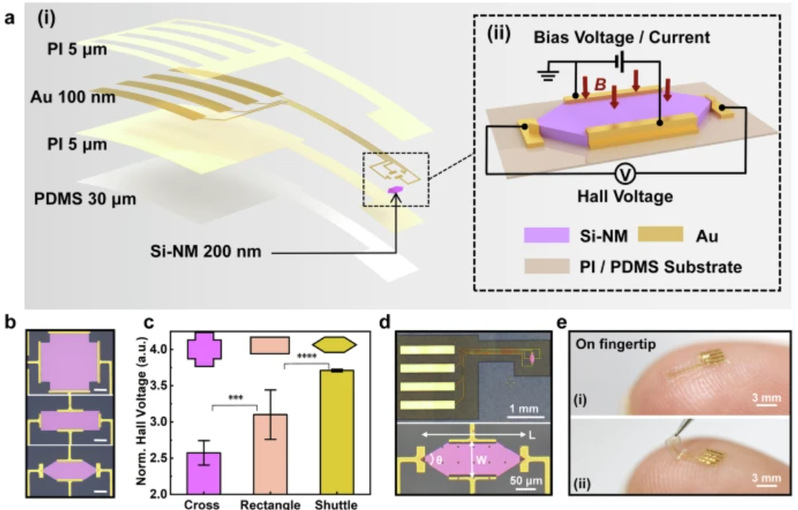
图1:柔性单晶硅纳米薄膜霍尔传感器的材料、设计及原理
阵列设计与深度学习架构的集成,特别是卷积神经网络,使大面积组织表面映射能够量化肿瘤体积,并利用残差神经网络进行三维轮廓分析,增强了测量能力。在活体小鼠模型的整个肿瘤生长期间,霍尔传感器阵列持续监测肿瘤高度数周。通过CNN进行关键几何参数提取(即高度和体积),同时通过ResNN进行三维肿瘤轮廓重建(图2)。该工作为精准肿瘤学和个性化医学中的应用提供了更广阔的前景,代表了癌症管理中动态、数据驱动方法的重要进步。
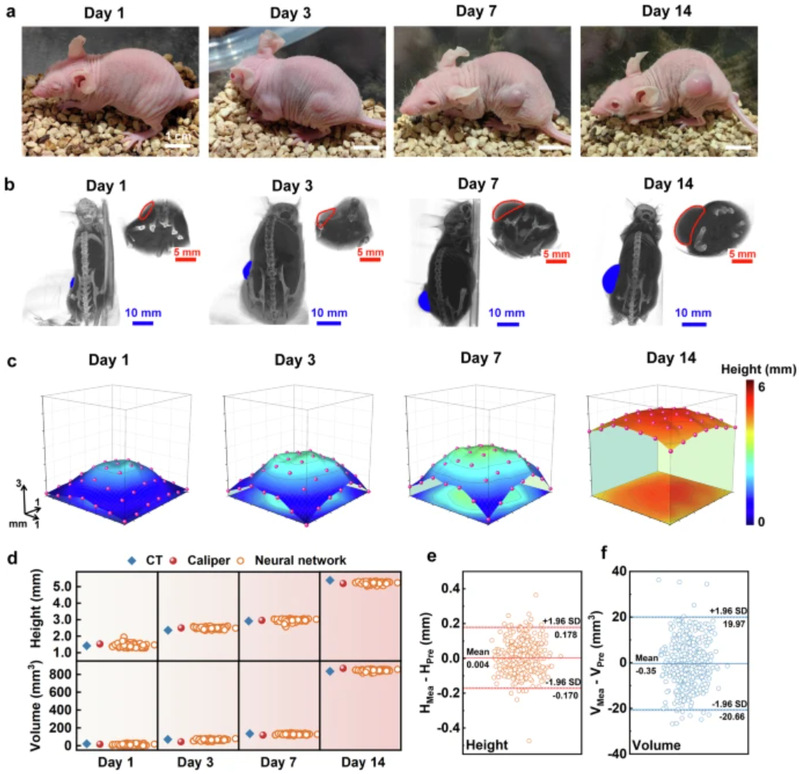
图2:在体三维肿瘤形貌重建结果
复旦大学智慧纳米机器人与纳米系统国际研究院刘俊含博士、吴忠原博后和周连杰博后为该论文共同第一作者,周连杰博后、陶灵青年研究员和宋恩名青年研究员为共同通讯作者。该工作得到了科技部科技创新2030重大项目、国家自然科学基金等项目的资助和支持。
文章信息:
Junhan Liu#, Zhongyuan Wu#, Lianjie Zhou#, Yanran Shen, Xiaojun Wu, Junling Liang, Yuting Shao, Pengchuan Liu, Zhongzheng Li, Bofan Hu, Ming Wang, Zengfeng Di, Tianjun Cai, Fan Xu, Su Jiang, Mengdi Han, Ling Tao*, Yongfeng Mei & Enming Song*, Conformal, ultrathin crystalline-silicon-based Hall sensor arrays with deep learning models for early-stage monitoring of three-dimensional tumor tissues, npj Flexible Electronics, 2025, 10, 16.
原文链接:https://www.nature.com/articles/s41528-025-00518-0
Conformal, ultrathin crystalline-silicon-based Hall sensor arrays with deep learning models for early-stage monitoring of three-dimensional tumor tissues
Dynamic dimension assessments of tumor tissues have broad relevance in clinical diagnosis and the treatment of patients. Current technologies for such a purpose include quasi-static measurements that lack microscale resolution and sensing sites, with limited capabilities for time-dependent, three-dimensional profiling of tumors, particularly at the early growth stage. Here, we report the conformal Hall-sensor-based systems for continuous monitoring of tumor morphological features such as growth rates and volumes. Such platforms incorporate ultrathin crystalline-silicon nanomembranes (200 nm thick) as a basis for displacement sensing via magnetic flux detection, in an array design that yields spatiotemporal information of tumor geometries at high sensitivity. Evaluation involves real-time measurements on a living mouse model with tumor tissues at various pathological conditions, where the integration with deep learning algorithms can further enable the system for large-scale tumor profile reconstruction across tissue surfaces. These microsystems provide the potential for monitoring of tumor progression and treatment guidance in patients.
Article information:
Junhan Liu#, Zhongyuan Wu#, Lianjie Zhou#, Yanran Shen, Xiaojun Wu, Junling Liang, Yuting Shao, Pengchuan Liu, Zhongzheng Li, Bofan Hu, Ming Wang, Zengfeng Di, Tianjun Cai, Fan Xu, Su Jiang, Mengdi Han, Ling Tao*, Yongfeng Mei & Enming Song*, Conformal, ultrathin crystalline-silicon-based Hall sensor arrays with deep learning models for early-stage monitoring of three-dimensional tumor tissues, npj Flexible Electronics, 2025, 10, 16.
Article link:https://www.nature.com/articles/s41528-025-00518-0