
相位轮廓的对称性决定了超构表面操纵电磁波的方式。因此,只需改变这种对称性即可直接实现波束控制。传统的机械调控方法(如弹性拉伸和单胞剪纸结构)虽然可以改变晶格常数和元原子取向角,但其相对顺序保持不变,限制了可达到的对称性。
近日,复旦大学智慧纳米机器人与纳米系统国际研究院/智能机器人与先进制造创新学院梅永丰/崔继斋研究团队报道了一类超原胞剪纸(Supercell Kirigami)结构,其中多个具有不同相位特性的元原子被安装在同一个刚性面板上。在驱动过程中,这些面板不仅发生拉伸、旋转变形,还改变了元原子的顺序。在壁纸群(Wallpaper Group)设计原理的指导下,课题组制备了多种剪纸超表面(包括旋转方块和交错旋转矩形超晶胞),并实验实现了五种对称型变化路径,包括此前难以实现的从pmm 到 p4m 以及 pmm 到 pmg 的变化路径。由于剪纸结构具有尺度和材料无关性,该策略可轻松扩展到更高频率范围。相关成果以《Reconfigurable Phase Profile Symmetry in Kirigami Metasurfaces》为题发表在Advanced Optical Materials上。
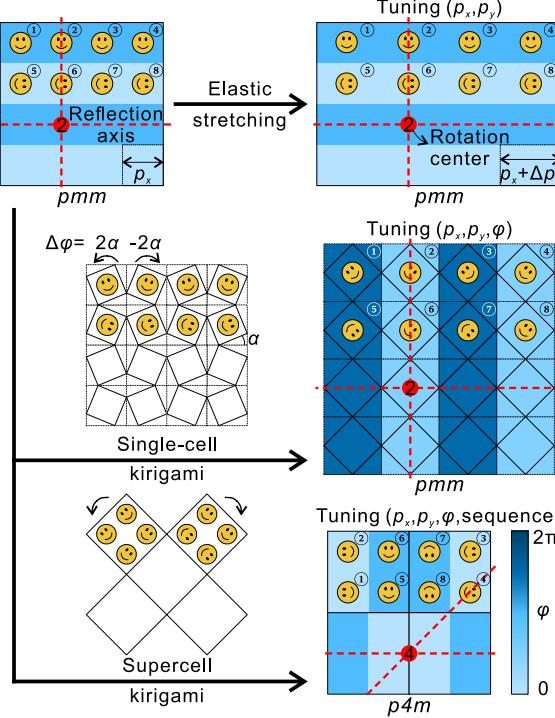
图1:三种不同平面变形方式对相位轮廓对称性的影响
作者系统地研究了几种不同机械变形模式重塑如何相位轮廓对称性(图1),并通过精心设计的剪纸变换,揭示了一组丰富的对称型变化路径,极大地扩展了机械可重构超构表面的功能。从平方晶格上的单个晶胞出发,作者遍历了相位轮廓的所有12种平面对称类以及它们覆盖的78种对称型变化路径。仅通过改变晶格常数,纯衬底弹性拉伸可以达到其中的21条路径;加入旋转后(同时改变元原子取向角),经典的单晶胞旋转方块剪纸结构能够将路径数扩展至33(图2)。为了实现剩余的路径,作者引入了超胞-壁纸群设计。这种设计实现了元原子顺序的重构,提供了两个晶格常数和取向角以外的第四个机械调控自由度。利用这一策略,作者演示了五种典型对称型变化路径,包括一种此前无法达到的路径。这些器件实现了从双波束到四波束的波前动态调制,并可将异常反射从对角线方向重定向到平行方向,这些都是现有机械可重构超构表面尚未实现的功能。通过开发壁纸群剪纸构型中的其他选项,有望实现所有78种对称型变化路径。
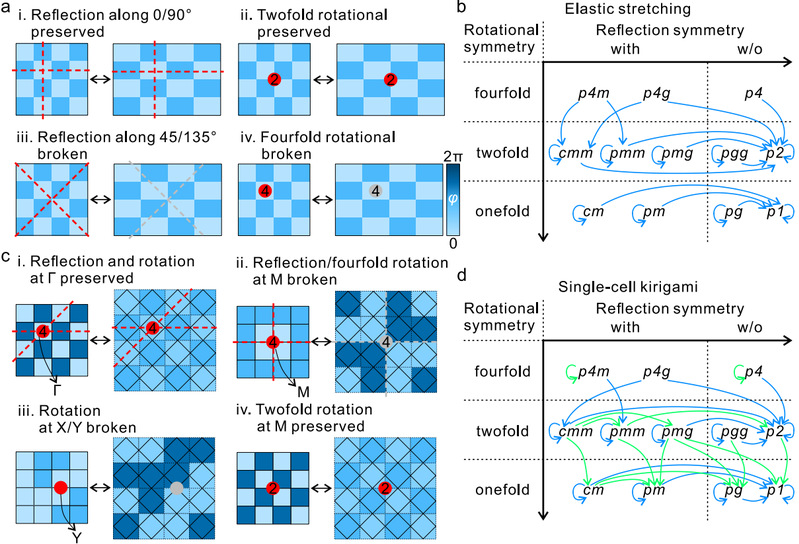
图2:拉伸和单原胞旋转方块对相位轮廓对称性影响的系统性分析
复旦大学智慧纳米机器人与纳米系统国际研究院蒋国邦博士为该论文第一作者,崔继斋研究员为通讯作者。该工作得到了国家重点研发计划、国家自然科学基金、上海市科委、上海市青年科技启明星等项目的资助和支持。
文章信息:
Guobang Jiang, Ziyu Zhang, Yang Wang, Xing Li, Zhi Zheng, Yongfeng Mei, Lei Zhou, Shulin Sun, Jizhai Cui*, Reconfigurable Phase Profile Symmetry in Kirigami Metasurfaces, Advanced Optical Materials, 2026, 14(5), e03586.
原文链接:
https://advanced.onlinelibrary.wiley.com/doi/abs/10.1002/adom.202503586
Reconfigurable Phase Profile Symmetry in Kirigami Metasurfaces
The symmetry of the phase profile dictates how a metasurface manipulates electromagnetic waves. Altering that symmetry therefore directly enables wave control. Conventional mechanical methods such as elastic stretching and single-cell kirigami vary lattice spacings px, py and meta-atom orientation but leave the ordering unchanged, limiting the accessible symmetries. Here, supercell kirigami is introduced, where several phase-distinct meta-atoms are mounted on each rigid panel. During actuation, the panels stretch, rotate, and, crucially, reorder their meta-atom sequence. Guided by wallpaper group design principles, a variety of kirigami metasurfaces including rotating square and staggered rotating rectangle supercells, are fabricated, and experimentally realize five symmetry transitions, including the previously inaccessible pmm to p4m and pmm to pmg routes. Broadband measurements confirm wavefront conversions from dual to quad beams and redirection of reflected beams by 45°. Because the kirigami architecture is scale- and material-independent, the same strategy readily extends to higher frequency regimes. Operating at the phase map level rather than relying on resonator physics, this approach can also be applied to acoustic and thermal metasurfaces and even photonic crystals, opening broad prospects for reconfigurable wave devices.