

导读 实现光子与电子的单片集成是构建高带宽通信和高性能计算系统的关键。在这一领域,如何在保持紧凑尺寸的同时不牺牲器件性能,始终是一个巨大的挑战。传统的平面微环谐振器受限于相位匹配条件,往往尺寸较大;而基于纳米薄膜卷曲技术的三维微管谐振器虽然极大地减小了占地面积,但其轴向(长度方向)的光场泄露却严重制约了品质因子(Q值)的提升。此外,如何在微管中引入光电探测功能而又不破坏其光学储能特性,更是实现光电协同的难点。
近日,复旦大学梅永丰教授与中国科学院上海技术物理研究所吴斌民博士提出了一种新型的三维光电集成方案。他们利用应变诱导自卷曲技术,制备了集成石墨烯的氮化硅(SiNx)微管谐振腔,并通过独特的“波瓣”(Lobe)结构设计实现了轴向模态的量子化限制,大幅提升了光电性能。该器件在保持高Q值的同时实现了高效的光电读出与偏振敏感探测。相关研究成果以“Graphene-Integrated Microtube Whispering-Gallery Mode Resonators for Polarization-Sensitive Optical Modulation and Photodetection”为题发表于 Light: Science & Applications。蔡天骏与张子煜为论文共同第一作者,梅永丰教授与吴斌民博士为通讯作者。
波瓣结构:构筑光子的“势阱”
对于传统微管谐振腔,光场沿管壁圆周传播可形成回音壁模式(WGM),但在轴向方向通常为自由传播。这种不受限的轴向扩散会显著增加能量耗散,限制谐振腔品质因子(Q 值)的提升。
为了解决这一问题,研究团队在微管设计中引入了“波瓣”图样结构(Lobe structure)。当自卷曲为微管时,即可在轴向构建梯度有效折射率分布,从而形成等效的势阱,并实现轴向能级的离散化与量子化约束。。实验表明,这种设计有效抑制了光能耗散,将微管腔的品质因子(Q值)提升至 3000 以上,实现了对光场的有效“囚禁”。
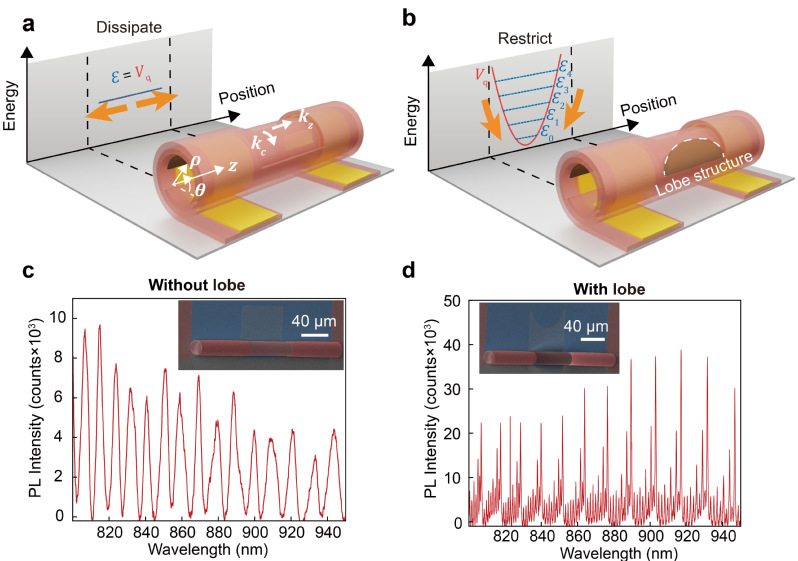
图1:波瓣结构微管腔的轴向光场限制原理 (a) 普通微管腔中光场沿轴向耗散;(b) 引入波瓣结构后形成势阱,光场被限制在特定能级。(c) 普通微管腔的荧光发光谱,谐振腔的各个模式的谐振峰能级单一。(d) 引入波瓣结构后,谐振峰发生能级劈裂,品质因数提高。
石墨烯集成:光与电的完美平衡
为了将微管中的光信号转换为可处理的电信号,团队将单层石墨烯(Graphene)集成在微管壁内。石墨烯原子级的厚度使其对光腔的扰动极小,同时具备极高的载流子迁移率。石墨烯集成存在权衡:较长的覆盖长度可增强吸收,但相应降低Q 值;过短则无法实现有效光电响应。研究人员通过精细调节石墨烯的覆盖长度,找到了最佳平衡点(30 μm)。在该长度下,器件在保持高Q值(2008.36)的同时,实现了高达 2.80 A W⁻¹ 的光响应度,成功打破了光学谐振与光电探测之间的壁垒。
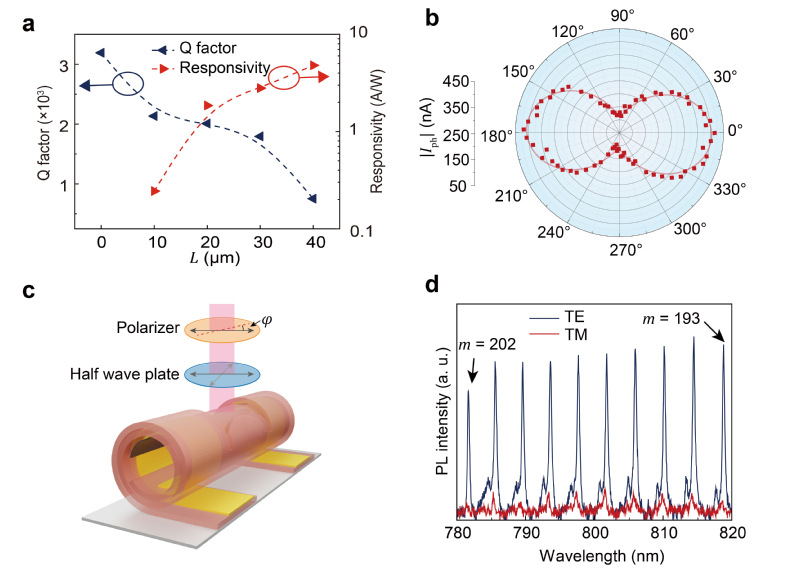
图2:不同石墨烯长度下的Q值与响应度平衡 (a) 随着石墨烯长度增加,响应度提升但Q值下降;(b) 优化后的器件实现了高偏振比响应。(c) 器件的偏振测试实验示意图。(d) 器件在不同偏振光下的PL谱。
对称性破缺:几何结构自发引入偏振光敏感
自卷曲过程中,平面纳米薄膜的四重旋转对称性被打破,赋予了微管腔独特的偏振特性。微管对不同偏振方向(TE模与TM模)的光表现出选择性响应。TE 模(电场平行于微管轴)可在管壁形成稳定驻波并实现有效耦合与储能,而 TM 模(电场垂直于微管轴)因壁厚远小于波长,难以形成稳定驻波,从而耦合与储能显著减弱。器件的 PL 谱在不同偏振角条件下呈现明显的强度差异,TE/TM 模的峰值强度比显著。结合石墨烯在平行电场方向具有更高的面内吸收系数,TE 模与石墨烯的相互作用更强,进一步提升了偏振选择性。
总结与展望 这项工作提出了一种通用的三维光电集成平台。其“自卷曲+波瓣结构”的设计理念并不局限于氮化硅和石墨烯,未来可扩展至硅基、铌酸锂等多种材料体系。该技术可结合其CMOS 工艺兼容性与晶圆级可扩展性,并为片上光传感、神经形态计算以及下一代智能光子芯片的发展提供了全新的设计范式。
论文信息 Cai, T., Zhang, Z., Wu, B., et al. Graphene-Integrated Microtube Whispering-Gallery Mode Resonators for Polarization-Sensitive Optical Modulation and Photodetection. Light Sci Appl (2025).
注明:文章内容转载自LightScienceApplications公众号
Graphene-integrated microtube resonators with lobe structures for optical modulation
Scientists from Fudan University have developed a graphene-integrated silicon nitride microtube resonator via self-rolling nanomembrane technology. By engineering a lobe structure, they achieved axial mode quantization, creating a potential well that confines light and significantly enhances the quality factor. The device demonstrates high photoresponsivity (2.80 A W-1) and intrinsic polarization sensitivity, offering a versatile platform for compact, high-performance on-chip photonic-electronic systems.
Photonic devices are outpacing electronic circuits in bandwidth and speed, yet the seamless integration of photonics and electronics remains a critical challenge for high-performance computing and communication. While planar microring resonators are common, their large footprint restricts high-density integration.
Three-dimensional (3D) microtube resonators formed by rolled-up nanomembranes offer a solution with a significantly smaller footprint. However, conventional microtubes suffer from light leakage along the axial direction of microtube, which degrades the quality factor (Q-factor) and limits performance. Furthermore, integrating photodetection capabilities into these resonators without destroying their optical storage properties has proven difficult.
In a new paper published in Light: Science & Applications, a team of scientists led by Professor Yongfeng Mei from Fudan University and Doctor Binmin Wu from Shanghai Institute of Technical Physics has developed a novel 3D photonic-electronic platform. They utilized strain-engineered self-rolling technology to fabricate silicon nitride (SiNx) microtube resonators integrated with graphene, featuring a specialized lobe geometry.
The core innovation lies in the light localization in the lobe structures. The engineered lobe-shaped architecture in the microtube facilitates axial mode quantization. This design creates a gradient refractive index that acts like a quantum potential well, trapping light within specific regions of the tube and preventing it from escaping axially.
This structural innovation leads to a significant performance boost. By tuning the length of the integrated graphene, the team achieved an optimal balance between optical confinement and electrical readout efficiency. The graphene-integrated microtube resonators with the lobe structure demonstrate an efficient optical resonance (Q ≈ 2008) and high photoresponsivity (2.80 A W⁻¹).
Additionally, the rolling process naturally breaks the rotational symmetry of the nanomembrane. This asymmetry grants the device polarization sensitivity, allowing it to distinguish between transverse electric (TE) and transverse magnetic (TM) modes with a polarization ratio of approximately 4.3.
The overall characteristics present a promising platform for optical manipulation and multidimensional detection of integrated photonic and optoelectronic systems, the scientists forecast. This technology provides a scalable foundation for realizing complex three-dimensional integrated photonic systems with unprecedented functionality and miniaturization.