
生理力学信号的连续动态监测是脑部疾病诊疗、心血管健康评估的关键支撑,现有可穿戴与植入式监测器件普遍存在有线束缚、体积刚性大、感染风险高、传感精度不足等痛点,无法满足长期微创在体监测的临床需求。
近日,复旦大学智慧纳米机器人与纳米系统国际研究院/智能机器人与先进制造创新学院研究团队开发出一款无线无电池、全柔性超薄铌酸锂压电谐振器,成功实现穿戴式生命体征与植入式颅内压的高精度无源监测。相关成果《Wireless battery-free ultrathin lithium niobate resonator as wearable and implantable electronics for continuous monitoring of mechanical vital signs》以研究论文发表于Nature Communications上。
研究团队以3μm厚单晶铌酸锂薄膜(LNTF)为核心传感单元,结合悬浮结构设计与叉指电极工艺,构建了品质因子(Q≈300)的高性能压电谐振器,器件整体厚度仅10μm、重量约3mg,具备极致柔性与生物贴合性。该器件基于电感耦合无线传感原理,无需电池与集成芯片,通过谐振频率偏移定量捕捉力学形变信号,可精准检测动脉脉搏波形、呼吸暂停等穿戴式生理信号,同时实现0.15 mmHg 的超低检测限、0-240 mmHg 宽量程的植入式颅内压监测。大鼠在体实验验证,器件可稳定追踪脑积水病理下的颅内压动态变化,28天长期植入无明显炎症反应,生物相容性优异(见图1)。
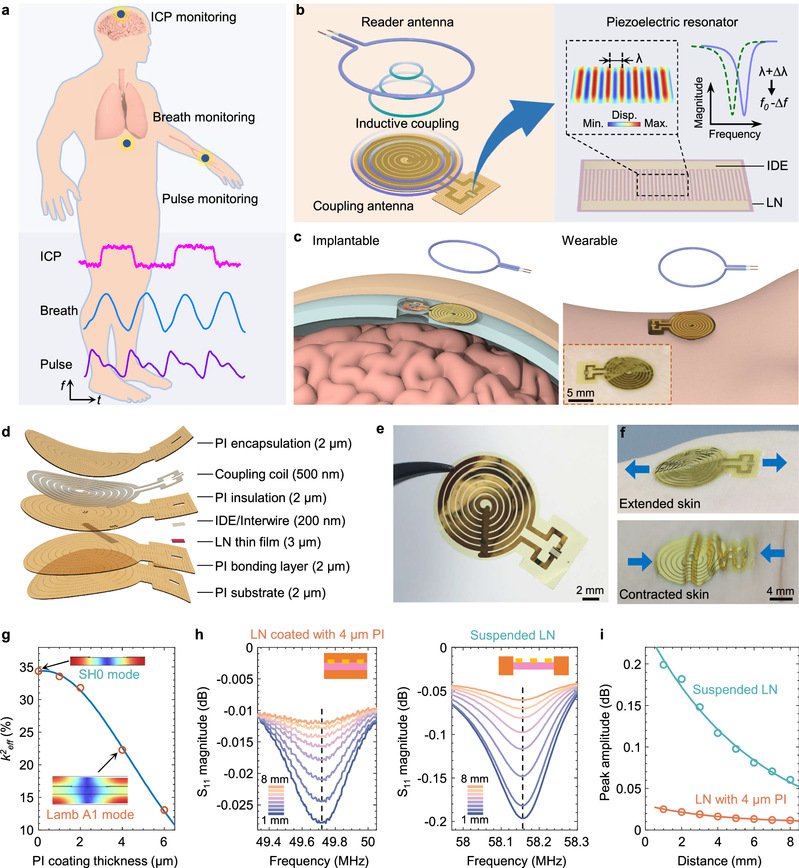
图1:基于超薄压电谐振器的无线设备的工作原理、材料及设计
该工作突破了传统生物电子器件的供电与形态限制,构建了柔性无源的多场景生理传感平台,为临床神经疾病监测、居家健康诊疗提供了颠覆性技术方案(图2)。
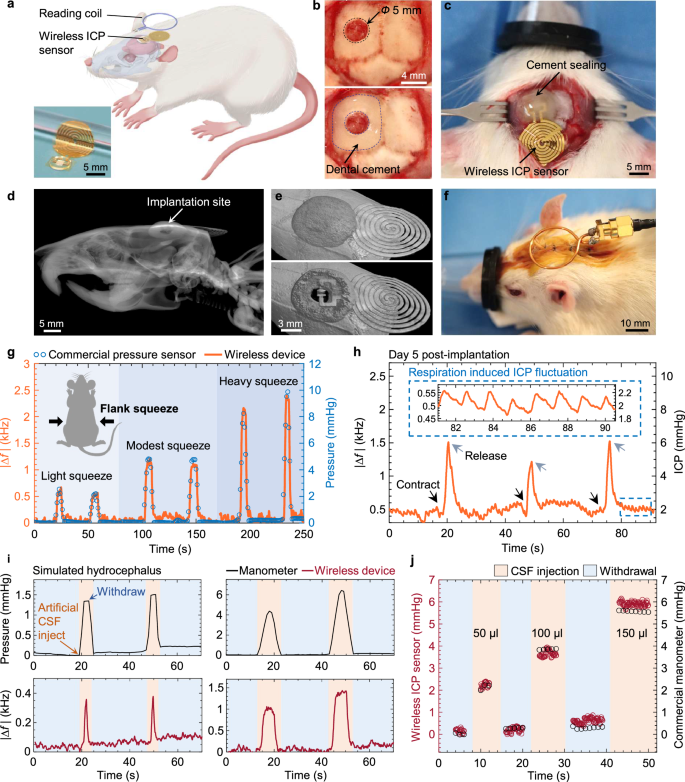
图2:大鼠模型中的体内无线颅内压监测
复旦大学智慧纳米机器人与纳米系统国际研究院周连杰博士后、刘鹏川博士为论文共同第一作者,研究得到国家重点研发计划、国家自然科学基金、上海市科委等项目的资助和支持。
文章信息:
Lianjie Zhou#, Pengchuan Liu#, Junhan Liu, Wenlou Yuan, Zhongyuan Wu, Bofan Hu, Yuting Shao, Yifei Lu, Ningge Huang, Jiahao Li, Zhongzheng Li, Fuying Liang, Xiaojun Wu, Lichao Ma, Ming Wang, Zengfeng Di, Rui Li, Yanlong Bi, Fan Xu, Yongfeng Mei, Enming Song*, Wireless battery-free ultrathin lithium niobate resonator as wearable and implantable electronics for continuous monitoring of mechanical vital signs, Nature Communications, 2026, 17, 642.
原文链接:https://doi.org/10.1038/s41467-025-67413-0
Wireless battery-free ultrathin lithium niobate resonator as wearable and implantable electronics for continuous monitoring of mechanical vital signs
Continuous monitoring of physiological parameters associated with dynamic biomechanics, such as intracranial pressure (ICP) and vital signs, is important for clinical diagnosis of brain diseases and timely medical intervention. Current skin-interfaced and implant technologies face challenges in terms of bulky tethers and/or percutaneous wires with high infection risks. Here, we report the wireless, battery-free, and lightweight devices for both wearable and fully implantable applications. The devices incorporate an ultrathin piezoelectric resonator with suspended lithium niobate thin film (LNTF, 3 μm thick), enabling the wireless tracking of mechanophysiological signals by detecting variations in resonance frequency. We experimentally and computationally establish the operational principles of the resonator sensor and assess the device performance as wearables for dynamically monitoring artery pulse and apnea events during respiration. Implantable wireless pressure sensors adapted from this scheme allow for untethered, minimally invasive ICP sensing with a low detection limit of 0.15mmHg over a wide range up to 240mmHg. In vivo experiments performed on rat models validate the device capabilities of accurately capturing clinically relevant ICP variations and elevated levels of ICP under pathophysiological conditions of hydrocephalus, with excellent biocompatibility after long-term implantation periods. These findings create the clinical significance of such battery-less and wireless devices for precise characterization of dynamic biomechanics of living tissues.
审核:黄高山、陈相仲