
神经调控通过干预神经活动,为神经系统疾病诊疗、脑功能研究和神经康复提供了重要技术手段。传统神经调控主要依赖电刺激,或光、磁、超声等物理刺激。随着微系统工程、纳米技术和光遗传学等快速发展,神经接口正朝着高时空分辨率、多模态和闭环化方向演进。其中,有源器件具备信号放大、处理、能量转换和受控驱动等功能,能够在统一平台上协同完成神经信号记录、分析与刺激,为自适应闭环调控提供关键器件基础。
近日,复旦大学智慧纳米机器人与纳米系统国际研究院/智能机器人与先进制造创新学院梅永丰教授、宋恩名教授团队在工程技术领域一区Top期刊《Microsystems & Nanoengineering》发表题为《Active devices and systems for closed-loop neuromodulation》的综述论文。该综述围绕有源器件在闭环神经调控中的功能作用,系统梳理了神经信号耦合与放大机制,以及电、光、机械、磁、热等不同物理模态下器件的工作原理和性能特点;在此基础上,进一步总结了多模态神经接口的系统集成策略、代表性应用及临床转化前景。
在器件层面,文章首先归纳了用于神经调控的主要有源器件类型。不同器件可在供能模块支持下,将电、光、声/机械、磁和热等外部能量转换为可控的神经调控信号,并通过影响神经元兴奋性实现神经活动调节。文章还从离子-电子信号耦合角度,对场效应耦合、界面离子积累、体相离子渗透及电化学反应等机制进行了比较,阐明了不同器件在响应速度、灵敏度和生物电子应用方面的特点与权衡,为按需选择调控模态和开展多模态集成提供了清晰的器件基础。
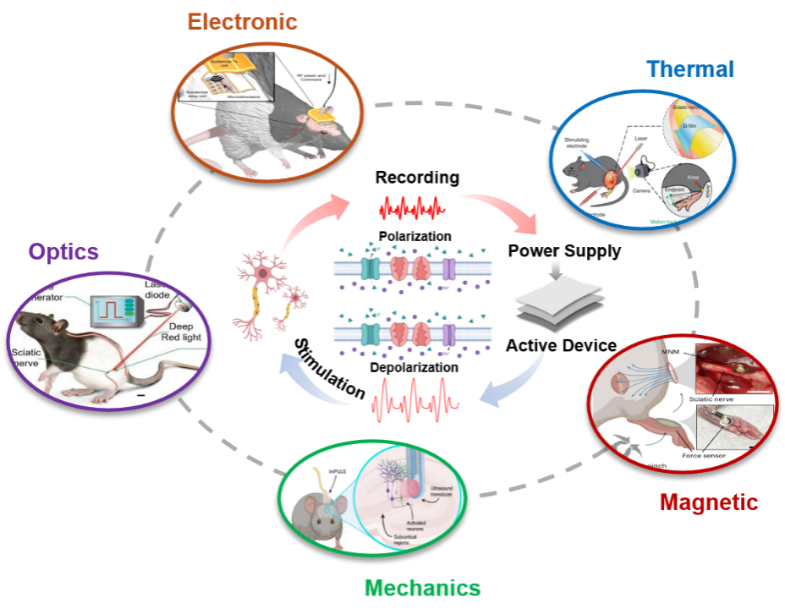
图1:不同类型的有源神经调控器件与系统
在系统层面,文章进一步总结了有源神经调控系统在柔性集成、微型化、无线供能和体内验证等方面的代表性进展。通过将神经记录、信号处理、精准刺激和反馈控制等功能集成于同一平台,相关系统可实现更稳定、更高保真的神经活动监测与调节,并已在外周神经刺激、神经再生、运动功能恢复和感觉反馈等场景展现出应用潜力。文章同时指出,现有系统仍面临长期稳定性、生物相容性、刺激选择性及自适应控制能力等挑战。未来,随着有源半导体器件、多模态传感、片上信号处理和智能算法进一步融合,闭环神经调控有望向更加自主、精准且适于长期临床应用的方向发展。
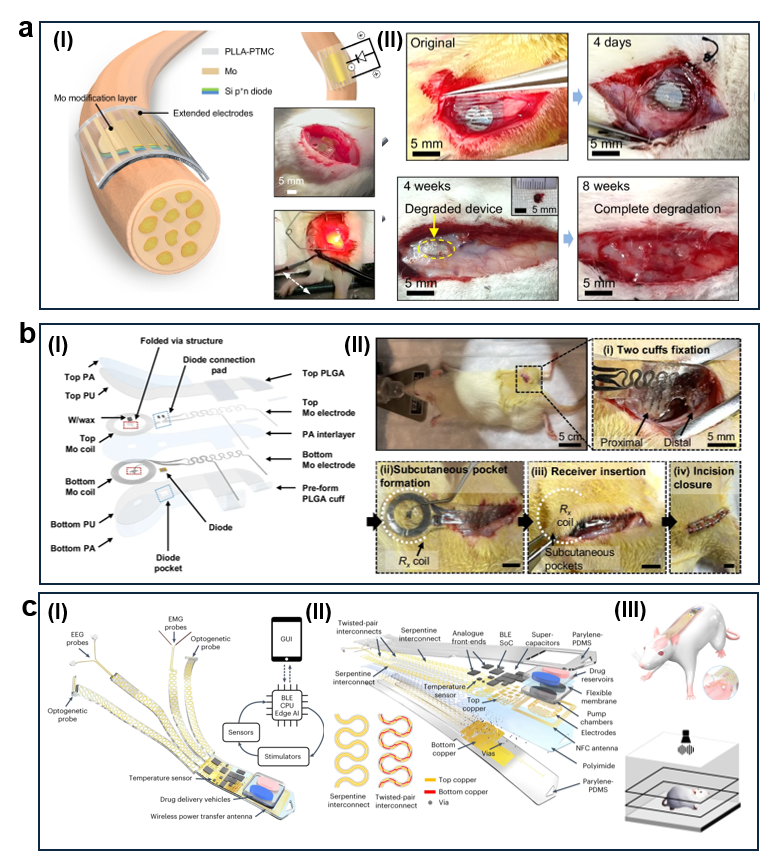
图2:面向闭环调控的代表性有源神经调控平台及其应用
复旦大学博士后王婧菲、薛惠泽和黎家豪博士为论文共同第一作者,梅永丰教授、宋恩名教授为共同通讯作者。该工作得到了科技部科技创新2030重大项目、国家自然科学基金等项目的资助和支持。
文章信息:
Jingfei Wang#, Huize Xue#, Jiahao Li#, Yihong Li, Rui Li, Yongfeng Mei* & Enming Song*, Active devices and systems for closed-loop neuromodulation, Microsystems & Nanoengineering, 2026, 12, 253.
原文链接:
https://doi.org/10.1038/s41378-026-01357-3
Active devices and systems for closed-loop neuromodulation
Neuromodulation has become a central topic in neuroscience and biomedical engineering, as it provides powerful means to interrogate and regulate neural activity and offers promising therapeutic strategies for a wide range of neurological disorders. Conventional neuromodulation approaches predominantly rely on electrode-based electrical stimulation or remote physical stimuli, including optical, chemical, magnetic, and ultrasound-based methods, to influence neuronal excitability and neural circuit dynamics. Recent advances in neuromodulation involve microsystem engineering, nanotechnology, and genetically enabled techniques such as optogenetics. They have achieved increasingly precise and versatile control over neural systems with high spatial and temporal resolution. Owing to their intrinsic capability for integrated sensing, signal amplification, and adaptive regulation, active devices are particularly well suited for system-level implementations of neuromodulation. This review summarizes recent advances in active devices for neuromodulation, with a particular emphasis on their functional roles in neural regulation. By discussing different material platforms and device architectures, this review further provides insights into the rational design of next-generation neural interface systems.
审核:黄高山、陈相仲